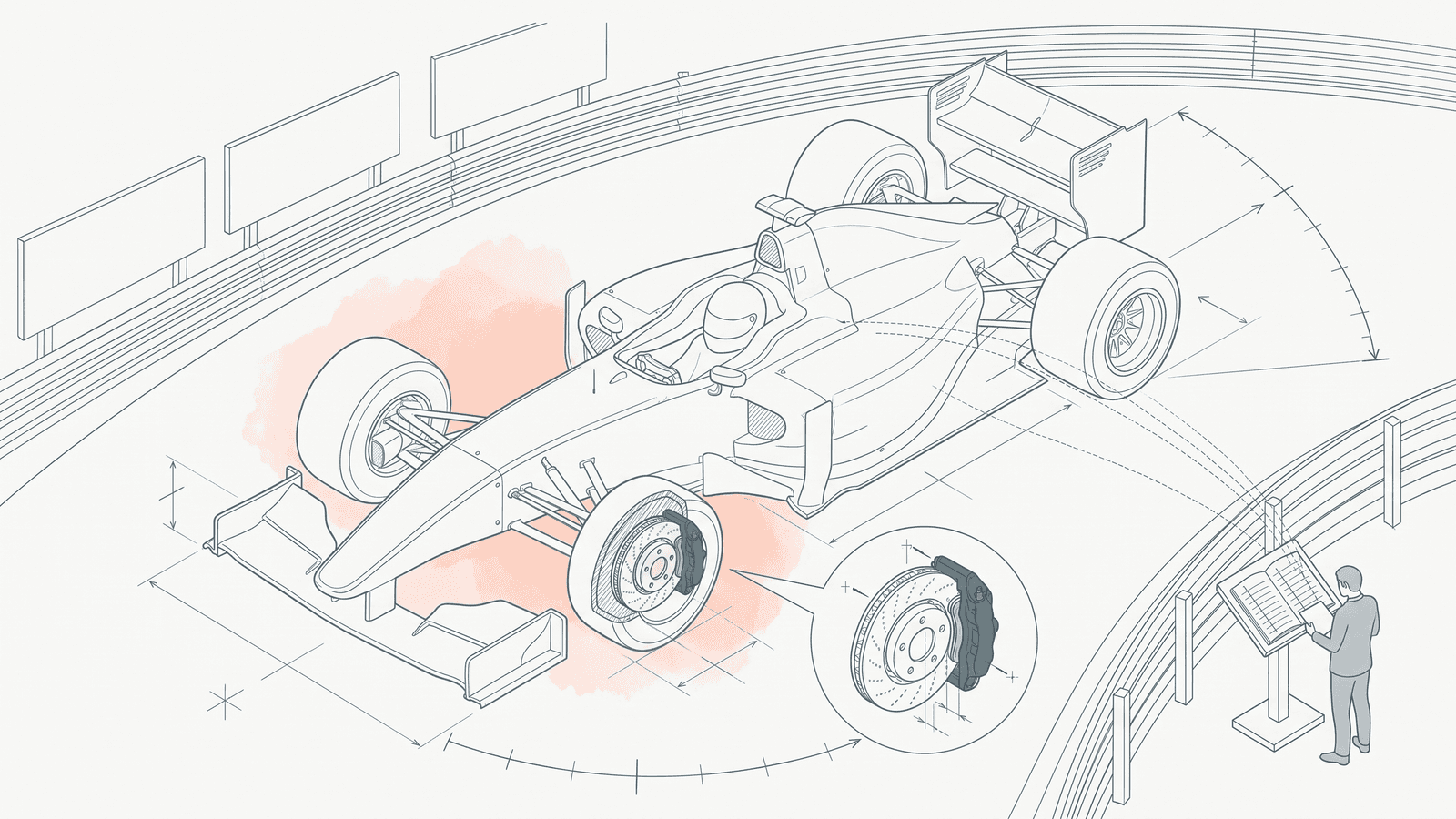
Ask a racing engineer what makes a car fast and you may get an answer that sounds backwards: the brakes. A driver who trusts the brakes carries speed deep into the corner. A driver who does not lifts early, every lap, and loses time everywhere.
Good brakes do not slow the car down. They are the reason it can be driven hard. For years AI governance has been sold, and resented, as the opposite. Risk teams were the people who said no. Compliance was the cost of doing AI, paid reluctantly and kept as small as possible. Most boards we speak to still see it that way: a necessary drag on the thing that actually creates value.
In September, Boston Consulting Group published a report that should end that view. The Formula for Agentic AI Value, the 2026 edition of its Applied AI Index, finds that companies with a full set of controls over their AI agents report about three times as much value from those agents as companies with just one. In BCG’s own words: “Effective risk controls serve as an enabler, not a brake.”
That is the good news, and it deserves a wide audience. Our argument starts one step further along, and we will make it directly. BCG has measured what control is worth inside a company. Whether that value holds outside it, with a regulator, an insurer, a client or the person an agent decides about, depends on whether someone who did not build the controls can check them. Today almost nobody can. Ask a board what its agents are worth and whether they are under control, and the honest answer is usually: we believe so. Control is what triples the value. Proof is what lets anyone else count on it. That gap is the one validant.ai exists to close.
Who this is for
This is for boards, chief risk officers, heads of AI and compliance teams who are putting agents into production or about to, and who will be asked to stand behind them. Part one summarises the report and needs no technical background. Part four walks through a concrete example. Part five is where we explain what validant.ai does about it, and why it changes what the threefold is worth.
We are not neutral. We build the tools and run the assessments that produce independent evidence about AI systems, and this article argues that the market needs them. We have kept the summary of BCG’s report separate from our argument about it, and we say plainly where our own tools are not finished.
Executive summary
- 01
Value from AI is real, and concentrated
Companies that combine strategic clarity with applied AI report about five times as much AI value as companies that lack both. Agentic AI is the fastest-growing share of that value, from 17% in 2025 to a projected 39% by 2030.
- 02
Controls multiply it
Companies with six agent controls in place across the enterprise report roughly three times the agentic value of companies with only one. Just 5% have them, while 42% expect agents to make decisions without human approval by 2030.
- 03
Every control on the list is internal
None of the six looks at the people an agent decides about, and none involves anyone outside the company checking the result. The words fairness and regulation do not appear in the report, and the survey itself is self-reported, as BCG notes.
- 04
Proof is the missing control
Fairness measured where people are affected, honest measurement that states what it could miss, and evidence sealed so outsiders can verify it. That turns governance from an internal belief into value others can rely on.
Part one · What BCG measured
The Applied AI Index is built on a survey of 1,330 CxOs and senior executives who make decisions about AI, in more than 60 countries and over 20 sectors, more than half of them at companies with over $5 billion in revenue. Its core idea fits on a napkin: strategic clarity plus applied AI equals transformative impact.
Strategic clarity is about choices. It means concentrating AI on a few high-value areas, running it as one funded, multiyear programme owned by the C-suite, and tracking what it is worth in the P&L rather than in slide decks. Applied AI is about execution. It has three parts: an operating model built around agents and the controls to run them, a workforce redesigned around humans and agents working together, and a data platform agents can actually use.
When both come together, the numbers move. Companies strong on clarity and applied AI realised AI value of about 4.5% of revenue in 2025. Companies weak on both realised 0.9%. That is the fivefold gap in BCG’s headline.
Four tiers, one small elite
BCG sorts companies into four groups. In 2026, 4.5% are stagnating, 47% are emerging, 41% are scaling and 7.5% are what BCG calls future-built, up from 5% a year earlier. The future-built group is where the value concentrates. Among them, 95% track AI value with clear KPIs or directly in the P&L, and they say they reach impact in about 11 months, against 17 for laggards.
A telling detail sits in the measurement data. Outside the leading group, most companies, in BCG’s phrase, are “flying blind”: 47% of laggards measure AI value directionally at best. A separate BCG analysis cited in the report found that while nearly nine in ten CEOs see cost or revenue benefits from AI, only 14% have clearly defined the P&L impact of every initiative.
Agents are where the next gains sit
The report’s subtitle is about agents for a reason. Agentic AI made up 17% of AI value in 2025 and 22% in 2026. BCG projects 39% by 2030, which would make it the largest single source of AI value. The gap here is sharper than anywhere else: 44% of future-built companies say they already realise full value from agents, against 2% of laggards.
| What BCG reports | Figure |
|---|---|
| AI value, strong vs weak on clarity and applied AI | 4.5% vs 0.9% of revenue (2025) |
| Share of companies that are future-built | 7.5% in 2026, up from 5% |
| Agentic AI’s share of AI value | 17% (2025), 22% (2026), 39% projected (2030) |
| Agentic value with all six controls vs only one | 1.8% vs 0.5% of revenue |
| Companies enforcing all six controls today | 5% |
| Companies expecting agents to decide without human approval by 2030 | 42% |
Read the numbers for what they are
One caveat runs through everything that follows, and BCG states it openly in its methodology. The figures come from executives estimating their own organisation’s maturity across 41 capabilities. Unless marked as realised in the 2025 P&L, value figures are expected future impact. And the answers “may be subject to perception bias”.
That is not a flaw in the report. It is the nature of a survey. But it matters for the argument, because it means the report is a careful picture of how companies see themselves. It tells us what executives believe about their AI and their controls. It cannot tell us whether those beliefs would survive an outside look. We return to that in Part three.
Part two · Six controls, three times the value
The part of the report that matters most for anyone deploying agents is a short list. Scaling agents, BCG argues, brings a risk it calls agent sprawl: duplicated agents, conflicting permissions, unclear ownership, gaps in monitoring. The deeper shift is that agents combine data, tools, memory and other agents across workflows, so risks can “emerge dynamically and compound at machine speed”. The old risk operating model, built for software that does what it is told, is not enough.
BCG names six controls that close the gap:
- 01Memory and context. How agents store and recall information. Memory can compound learning across agents, but it can also pass on errors, sensitive data or manipulated context from one workflow to the next.
- 02Scope and oversight. What each agent is for, what it may do, for which purposes, and when a human has to be involved. Authority is bounded not only by what an agent can reach, but by what it is permitted to do.
- 03Evaluation and rollback. Evaluation criteria, release gates, continuous monitoring and a way back. Controls should catch drift, anomalies and emerging risks after deployment, “not merely determine whether an agent was safe at launch”.
- 04Tools and integration. Standard ways for agents to use tools, APIs and data, with registries that show which agents are running, what they can access and how they interact.
- 05Ownership. A named person for every material agent, accountable for its use and outcomes, with clear authority over who can change, suspend or stop it.
- 06Security. Runtime controls, audit trails and cost guardrails that preserve enough evidence to reconstruct what an agent did, under whose authority, with which data and tools, and which controls it triggered.
The number that changes the conversation
Companies with all six controls in place across the enterprise report agentic value of about 1.8% of revenue. Companies with only one report 0.5%. That is the threefold difference, and BCG puts it bluntly: “Controlling agents does not diminish their value but triples it.” Read precisely, 1.8 against 0.5 is closer to 3.6, and the report quotes a 3.6-fold figure where it compares controls in force across the enterprise with controls only piloted. BCG chose the more conservative word, and so do we. Combining central risk guardrails with federated implementation brings three times as many workflows to scale as fully centralised steering.
Not all controls weigh the same. In BCG’s analysis of what drives value, memory and context carry the most weight (32 points of relative importance), followed by scope and oversight (21) and evaluation and rollback (18). Tools and integration (13), ownership (9) and security (7) follow behind.
The gap that comes with it
Next to the good news sits the uncomfortable number. 42% of companies expect agents to act autonomously by 2030, making decisions without human approval. Among future-built companies, two thirds expect bounded or full autonomy. Yet only 5% enforce all six controls today.
BCG also gives boards a job. They should set and periodically review the organisation’s AI risk appetite, while management keeps a complete inventory of agents. Boards should have visibility into the most consequential ones: their purpose, their authority, their key dependencies, and who can intervene or stop them. And they should review critical AI providers, single points of failure, contingency plans, and major incidents or control gaps.
“Effective risk controls serve as an enabler, not a brake: putting the right controls in place enterprise-wide roughly triples the value that agents create.”
BCG, The Formula for Agentic AI Value
Part three · What a self-reported control cannot tell you
The six controls are good engineering, and we would sign every one of them. Read them again, though, and notice who they are for. Every control on the list is something a company does to its own agents, for its own benefit, and reports about itself. That is the right list for capturing value. It is an incomplete list for anyone who has to rely on the result.
| BCG control | What it looks at | Who checks it |
|---|---|---|
| Memory and context | What the agent stores and passes on | The company |
| Scope and oversight | What the agent may do, and when a human steps in | The company |
| Evaluation and rollback | How the agent performs, and how to roll it back | The company |
| Tools and integration | Which tools, APIs and data the agent can reach | The company |
| Ownership | Who in the organisation answers for the agent | The company |
| Security | What the agent did, logged for audit | The company |
Three things are missing.
The people on the receiving end
Search the report for the word fairness and you will not find it. The same goes for bias in the sense of AI treating people differently, and for discrimination. There is no mention of the applicant, the borrower, the patient or the claimant an agent decides about.
That is a strange gap in a report about agents making decisions. BCG’s own examples include a health insurer whose incoming calls are mostly about benefits and coverage, and where agentic chatbots now handle about 60% of all incoming call types, and a business process outsourcer shifting from selling labour and time to selling AI-enabled outcomes. For insurers, the report ranks claims processing as the top source of AI value. These are exactly the places where an automated decision lands on a person. An agent can pass all six controls and still approve one group of applicants less often than another. Its memory is well configured, its scope bounded, its release gates in place, its tools registered, its owner named and every action logged. None of the six would notice, because none of them looks.
We made the deeper argument in Bias Is the Foundation: fairness is not a feature you add at the end. Bias enters through the data, the model and the human reviewer, and a feedback loop carries it back into the next round of training data. Agents add new places for it to enter: the tools they pick, the documents they retrieve, the notes they pass to each other.
Regulation
The report does not mention the EU AI Act. Under the Act as amended by the Digital Omnibus on AI, the obligations for the high-risk systems listed in Annex III apply from 2 December 2027. They cover AI used in hiring and managing workers, in assessing creditworthiness and scoring credit, and in risk assessment and pricing for life and health insurance. That date is fourteen months away. BCG says future-built companies reach impact in about eleven. An agent that goes into production this quarter will be running in its regulated state.
Liability arrives sooner. The revised EU Product Liability Directive treats software, AI systems included, as a product, and it applies to products placed on the market or put into service after 9 December 2026, nine weeks from now. For companies in those markets, several of BCG’s six controls stop being good practice and become duties. Evaluation after deployment, documented human oversight and records of what a system did are no longer choices. And once liability applies, the question a court will ask is not whether a company believed its controls worked. It is what the company can show. As we argued in The Preemptive Assurance Paradox, “the model did it” is not a defence.
Anyone outside the company
The third gap is the one the others lead to. A control that only its owner can check is a promise. It may be a sincere one, and it may be true. But a regulator, a customer, an insurer or an independent board member has no way to tell a working control from a well-described one.
The survey shows the same limit at scale. When 1,330 executives rate their own controls, the result is a careful map of self-assessment. BCG says so, and that honesty is to its credit. In Precision Is Not Proof we called this the difference between pointing and seeing: a claim can point at the right thing and still say nothing about how well it was seen. “We have evaluation and rollback in place” points at a control. It does not say what the evaluation could have missed.
“A control that only its owner can check is a promise, not evidence.”
Part three · What a self-reported control cannot tell you
None of this is a criticism of BCG. The report answers the question it set out to answer: how do companies capture value from agents? The question it leaves open is the one that decides whether that value holds up when someone else looks.
Part four · One loan committee, six controls
An example makes the gap concrete. It comes from the test objects we publish with our open library, vfairness, with the data and the harness, so anyone can rerun it.
Two agents form a small loan committee. A screener reads each application and writes a risk score and a one-sentence note for the reviewer. A reviewer scores and decides twice: once on the application alone, and once after reading the screener’s reply. We sent thirty applications, each under twelve names that signal gender and origin (Swiss, Kosovar and Nigerian) and once with no name as a control, twice over: 780 episodes, in which only the name changed. We kept each agent’s score and decision at every step, not just the final answer.
Now put the committee through BCG’s six controls.
- 01Memory and context. The screener’s note is exactly the kind of context BCG warns about: information one agent passes to the next. A good memory control decides how that note is stored, who can read it and how long it lives. It does not ask whether the note is fair.
- 02Scope and oversight. Both agents stay inside their scope. The screener screens, the reviewer reviews, a human can override.
- 03Evaluation and rollback. A typical release gate checks accuracy, latency and refusal rates. The committee passes.
- 04Tools and integration. Both agents are registered, with the right access.
- 05Ownership. There is a named owner who can stop the committee.
- 06Security. Every action is logged. The evidence is all there.
All six controls are green. Here is what the fairness test found in the same logs.
| Decision point | Spread of average risk scores across the six groups (100-point scale) | Confirmed by the data? |
|---|---|---|
| Screener | 3.4 points, from 43.8 (Swiss women) to 47.1 (Nigerian men) | Yes (p < 0.001) |
| Reviewer, on the application alone | 2.9 points, from 48.1 (Kosovar women) to 51.0 (Swiss men) | No (p = 0.06) |
| Reviewer, after reading the screener’s reply | 4.9 points, from 49.0 (Swiss women) to 53.9 (Nigerian men) | Yes (p < 0.001) |
| Amplification by the hand-off, as a separate effect | Suggested by the rise from 2.9 to 4.9 | Not established |
The screener scored the same applications differently depending on the name, by 3.4 points on a 100-point risk scale, and the difference was statistically clear. On the application alone, the reviewer showed a spread of 2.9 points that the data could not confirm. After reading the screener’s reply, the reviewer’s spread grew to 4.9 points and became clear.
One more detail matters, because it is where honesty costs something. The data suggest that the hand-off amplified the reviewer’s bias, but the rise itself did not pass the test, and our amplification analysis did not confirm it as a separate effect. So our report says exactly that: a confirmed disparity in the screener, a confirmed disparity in the reviewer after the hand-off, and amplification not established. It does not round the third finding up to a headline.
That is the point of the example. Every one of BCG’s controls worked as designed, and none of them could see the problem, because the problem was not in how the agents were run. It was in how they treated people. Seeing it took a different kind of control: one that measures outcomes by group, at the level of each agent and each hand-off, and says plainly how sure it is.
“All six controls were green. The disparity was in the logs the whole time. Nobody had asked the logs that question.”
Part four · One loan committee, six controls
Part five · From control to proof
We built validant.ai for the space between a control and the evidence that it works. Our approach has three steps, the same for a hiring model, a credit score or an agent: measure whether a system treats groups of people differently, explain what drives the difference, and prove the result in a form anyone can check.
How it lines up with BCG’s six controls
Here is the honest mapping, including what is not finished. We would rather publish a table with gaps than a claim we cannot back.
| BCG control | What validant.ai and vfairness do | Status |
|---|---|---|
| Evaluation and rollback | Fairness gates that block a release in the CI/CD pipeline, continuous monitoring with drift detection, and results that say “not enough evidence” instead of passing what they could not measure | Available today |
| Security and audit trail | Results record the method version and thresholds used, and agent and LLM runs also the library version, parameters and a UTC timestamp; the verdict is sealed as a signed credential that anyone can verify, with no account | Available today |
| Memory and context | Multi-agent tests that show when one agent’s output skews the next one’s decision, as in the loan committee above | Available in beta; so far checked against our own tests only |
| Tools and integration | Tests of whether an agent chooses tools or retrieves documents differently depending on who the case is about | Available in beta; one published tool-choice test object, none yet for retrieval |
| Ownership | The Trust Seal names the organisation accountable for the system, as that organisation declares it | Partly: we record ownership as declared; we do not yet verify or enforce it |
| Scope and oversight | Signed agent mandates that state what an agent may do on someone’s behalf, and can be revoked | Proposed, not built |
The control the list leaves out
If BCG’s list had a seventh entry, we would argue for this one: fairness, measured where people are affected. Not one aggregate score for the whole system, which can average a real problem out of sight, but measurement per group, per decision point and per hand-off between agents, with its statistical uncertainty stated and a third answer when the data cannot support either verdict. That is what our open library, vfairness, does. It covers training data, models, LLMs, agents and multi-agent systems, and it is free under Apache-2.0, so anyone can rerun our measurements and tell us where they disagree.
Three bodies, not one
In Digital Trust Is an Orbit, Not a Pillar we described trust in AI as the balance between three bodies: the model that decides, the organisation that answers for it, and the person it decides about. BCG’s six controls live almost entirely in the second body. They describe how an organisation runs its agents.
validant.ai adds the other two and connects all three:
- 01The model. We measure what the system actually does, by group, and explain what drives any gap.
- 02The organisation. We assess whether governance works as described, and name the accountable owner on the seal, as the organisation declares it.
- 03The person. In a worked demo, a job applicant received a Decision Receipt in a real personal wallet on swiyu, the public beta of Switzerland’s e-ID trust infrastructure: why the decision fell as it did, and how to ask for human review. The reasons in that demo were written by hand. Producing them from the deciding system, and bringing this body fully into the platform, is the next step on our roadmap.
Evidence that leaves the building
The step that matters most is the last one. We do not build, host or sell the systems we assess. Our results are issued as verifiable credentials, signed and checkable by a regulator, a customer or a board member without logging in and without trusting us. Every finding states what we could see and what we could not: how much access we had, how strong the method was, how recent the result is. A seal covers one system at one moment, and says so.
Why proof is what makes the threefold count
Put plainly: BCG’s threefold is value a company creates. Whether it keeps that value is decided by people who were not in the room when the controls were built. Each of them discounts a control they cannot check. The underwriter prices it as if it were absent. The procurement team sends the questionnaire again next quarter. The supervisor asks for the records behind the policy. The court treats the description as an assertion. That discount is the gap, and it is where the threefold leaks away.
| Who has to believe your controls | With an internal control only | With verifiable evidence |
|---|---|---|
| A regulator or supervisor | A description of the process, and a request for the records behind it | Results by group, signed and dated, that they can check without access to your systems |
| An insurer | A questionnaire answer, priced as if the control were absent | Measured disparities with their statistical uncertainty, and a statement of what the test could miss |
| A client buying AI-enabled outcomes | A contractual assurance, and the same questionnaire next quarter | A credential their own team can verify |
| The person an agent decides about | Nothing they can see | A receipt for the decision and a route to human review (demo stage today) |
| Your own board | A self-assessment | An outside view of the agents that matter most |
This is the direct case for what we do. The controls make agents governable. Independent, verifiable evidence makes that governance credible to every one of these readers at once. A company that can hand each of them something they can check does not have to argue for its threefold. It can show it.
“BCG shows companies how to control their agents. We help them prove it to someone who has no reason to take their word for it.”
Part five · From control to proof
Part six · What to do now
For a board, a risk committee or a team putting agents into production, the report and the gaps around it come down to six steps. None of them needs to wait for a regulator.
- 01Count your agents. You cannot control what you have not listed. Write down every agent that makes or shapes a decision, what it may do, which data and tools it touches, and who owns it. BCG asks management to keep exactly this inventory, and boards to see the most consequential agents in it. Most companies do not have one yet.
- 02Put the six controls in place everywhere, not in a pilot. BCG’s data say the value comes from having all of them, across the enterprise. A well-governed pilot next to ungoverned production is the worst of both.
- 03Add fairness to evaluation. For every agent that decides about people, test for differences between groups before release, and keep testing after, because agents drift and so do the people they serve. Test each hand-off between agents, not only the final answer.
- 04Measure honestly. A green result on a small sample proves very little. Ask every test how large a problem it could have missed, and treat “not enough evidence” as a finding, not a pass.
- 05Keep evidence others can check. Logs that only you can read are a start. Results that a regulator, an insurer or a customer can verify without trusting you are what will count when the liability rules, the AI Act or a large client come asking.
- 06Get an outside view on what matters most. Have at least your most consequential agents assessed by someone who did not build them. Not every agent needs it. The ones that decide about credit, jobs, health or money do.
Part seven · What we would like, and might not get
The tempting story writes itself. Boards read BCG, see that controls triple value, ask how they would know their controls work, and put independent assessment into the budget line BCG calls governance. We would like that story to be true. There are good reasons to be careful with it.
The threefold effect is a correlation. Companies with all six controls are also, very likely, better at many other things: data, talent, focus. BCG does not claim the controls alone cause the extra value, and neither should anyone quoting the figure, us included. The safer reading is that strong controls and strong results travel together, and that companies scaling agents without controls are taking a bet the leaders are not.
Fairness is not in the report, and that may say something about the market. If the executives BCG surveyed do not see fairness as part of agent governance, many buyers will not either, at least until a regulator, a court or a headline makes them. We think that view is short-sighted. We also know a better argument does not change budgets on its own.
Governance budgets are small. In BCG’s breakdown, governance is the smallest line in AI spending, about 0.3% of revenue out of 3.3%. Independent assessment has to fit inside that line, next to strategy, risk management and compliance.
Our own tools are not all mature. As the table in Part five shows, the agent and multi-agent tests are in beta and so far checked mainly against our own tests, and signed agent mandates are not built yet. We publish what we have verified and what we have not on our quality and hardening page, because an assessment provider that hides its own limits is making the mistake it exists to catch.
So this is an argument, not a forecast. We think the companies that capture the value BCG describes will be the ones that can show their controls work, not only the ones that have them. We would be glad to be argued with by anyone who sees it differently.
Trust is assessed, not asserted. If your organisation is putting agents into production and wants independent, verifiable evidence of how they behave, before the liability rules arrive in December and the AI Act’s high-risk duties in December 2027, our closed beta is open to a small group. Write to hello@validant.ai with the subject “Closed Beta”, or request a demo. To try the open engine today: pip install vfairness.
In one line
BCG has shown that controlling agents is not the brake on their value but the reason it multiplies. The next step is making that control visible: to the people agents decide about, to regulators, and to anyone who has to trust the result without taking your word for it. Brakes let you go fast. Proof lets others ride along.
“Trust is assessed, not asserted. A control nobody else can check is still an assertion.”
Controlling Agents Triples Their Value
Sources and further reading
- 01Apotheker, J., Beauchene, V., de Bellefonds, N., et al. (2026). The Formula for Agentic AI Value: The Applied AI Index 2026. Boston Consulting Group, September 2026. All BCG figures and quotations in this article are from this report.
- 02European Union. (2026). Regulation (EU) 2026/1744 (Digital Omnibus on AI), amending Regulation (EU) 2024/1689. Official Journal of the European Union, 24 July 2026. Sets the application of the Annex III high-risk obligations at 2 December 2027.
- 03European Union. (2024). Regulation (EU) 2024/1689 (the AI Act). Official Journal of the European Union. Annex III, points 4 and 5(b) and (c).
- 04European Union. (2024). Directive (EU) 2024/2853 on liability for defective products. Official Journal of the European Union. Article 2(1) and recital 13.
- 05validant.ai. vfairness test objects: the loan committee, with its run data, harness and executed notebook.
- 06validant.ai. vfairness on PyPI, Apache-2.0.
- 07validant.ai. Verify a Trust Seal: checks a seal’s signature and revocation status, with no account.
- 08validant.ai. vfairness quality and hardening: what is verified and what is not.
- 09Glinz, D. (2026). Precision Is Not Proof: The Trap in Every AI Fairness Verdict. validant.ai Signal.
- 10Glinz, D. (2026). The Preemptive Assurance Paradox: Who Guards the AI Guardrails? validant.ai Signal.
- 11Glinz, D. (2026). Bias Is the Foundation. validant.ai Signal.
- 12Glinz, D. (2026). Digital Trust Is an Orbit, Not a Pillar. validant.ai Signal.
- 13Glinz, D. (2026). Agents Will Act for Us. Who Vouches for Them? validant.ai Signal.
- 14Glinz, D. (2026). The Trust Problem Nobody Wants to Name. validant.ai Signal.
 ResearchOpen to read
Precision Is Not Proof: The Trap in Every AI Fairness Verdict
A model that predicts perfectly stops insuring anyone; a verdict published without its detection limit invites you to assume the limit is zero. Two failures, one omission, and two borrowed words for keeping them apart.
Read ResearchOpen to read
Digital Trust Is an Orbit, Not a Pillar
Trust is not one more pillar to stack. It is the orbit three bodies trace together: the model, the person and the organisation. Why the three-body problem is the honest metaphor for trustworthy AI, and how to tell where you are in the orbit.
Read ResearchOpen to read
The Preemptive Assurance Paradox: Who Guards the AI Guardrails?
In one September week a lab asked to slow down, a president declared himself the only guardrail AI needs, and The Economist asked whether the arms race can be stopped. Notes from Trust Valley Days 2026 at EPFL on why the answer is not a pause or a sprint, but liability, outcomes and verification.
Read