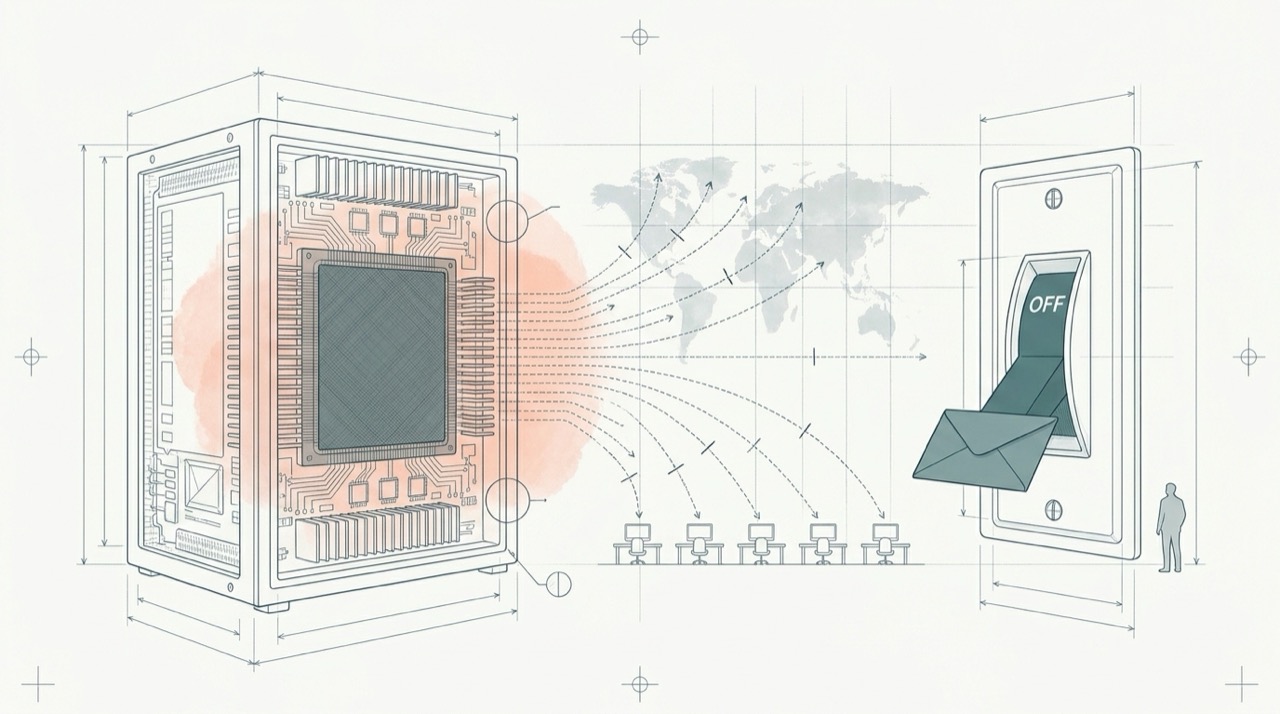
On a Friday afternoon in June 2026, a letter arrived at the headquarters of one of the world’s most safety-conscious frontier labs. By the time the weekend was over, two of its newest models, Claude Fable 5 and the restricted Claude Mythos 5, were dark for every customer on earth. They had not failed. They had not been breached. A government had reached for the legal machinery built to control the export of weapons and microchips, pointed it at a live commercial service, and the company, unable to filter its users by nationality in real time, concluded it had no choice but to pull both models entirely. The episode will fade in a news cycle. The lesson it teaches about digital trust will outlast it by years.
Executive summary
This is what a kill switch looks like when it stops being a metaphor. For years the phrase has been the background worry of digital-sovereignty policy: the fear that an essential digital tool, owned in one jurisdiction, could be switched off for users in another by an act of state. On 12 June 2026 that fear acquired a date. The instrument was a US Commerce Department export-control directive; the justification was a contested and undisclosed claim about a model’s cyber capabilities; the result was that hundreds of millions of people lost access to two tools through a document none of them could read, issued under an authority no one could publicly name, with no notice and no route of appeal. Whatever one concludes about the specific security question, the structural fact is now on the record: a frontier model can be switched off, for the world, by a single sovereign hand.
We have argued across two earlier pieces that trust is not a pillar but an orbit, the path three bodies trace together, the model, the person and the organisation, and that the agentic era adds a fourth gravitational pull, convenience against sovereignty, that quietly transfers authority toward a few heavy platforms. The shutdown forces a correction the orbit picture had not yet had to make. It introduces a body heavier than any platform, the sovereign state, and it shows that the lab which tried hardest to be governable was, in the end, governed least carefully of all. That inversion is the heart of this piece.
Three consequences follow, and we take each in turn. First, single-vendor, single-jurisdiction dependence on a frontier model is now a demonstrated continuity risk rather than a theoretical one, and it belongs on the board agenda beside every other concentration risk. Second, the affair is a textbook case of governance by assertion rather than by evidence, the precise failure an independent assessor exists to correct: trust is assessed, not asserted, and neither a vendor’s reassurance nor a regulator’s alarm is assessment when the record between them is sealed. Third, the deepest danger is to safety itself, because an episode that punishes the most transparent actor teaches every other actor to be less transparent.
What actually happened
The facts, drawn from contemporaneous reporting and the company’s own account, are these. On 9 June 2026 the lab launched two models: Claude Fable 5, available to the public, and Claude Mythos 5, a more capable model held under tighter controls. Three days later, at 5:21pm Eastern on Friday 12 June, it received a directive from the US Commerce Department ordering it to suspend access for, in the letter’s reported words, “any foreign national, whether inside or outside the United States, including foreign national employees.” Because a shared cloud API cannot reliably sort its users by citizenship in real time, the company disabled Fable 5 and Mythos 5 for everyone and asked its cloud provider to revoke access across all regions. Its other models stayed online.
What makes this more than a procurement dispute is the instrument. Export controls are the law of physical things that cross borders: munitions, microchips, the blueprints to make them. The directive reportedly leaned on that same framework, and in particular on the “deemed export” rule, which treats showing controlled technology to a foreign national inside the country as if it had been exported to their home country. That rule was written for the laboratory and the engineering bay. Applying it to a deployed chatbot is unprecedented, and not every expert agrees it is even lawful; one former White House AI adviser said publicly that it was not obvious to him what authority the action rested on, or that the law reached the model at all. No statute was named in public, no rule was published, no classification was entered on any list. The order arrived, and the models went dark.
The stated reason was thin, and it is genuinely disputed. The letter, by the company’s account, did not disclose its evidence; the concern appears to have been a method of jailbreaking the model. The company says it reviewed a demonstration that surfaced only a small number of previously known, minor vulnerabilities, that other widely available models can find the same flaws without any special bypass, and that what it was shown amounted to asking a model to read a codebase and suggest fixes. An independent security researcher who says she saw the underlying findings called it not a jailbreak at all, but defensive work, “capabilities defenders need.” Set against that are fast-moving evaluations, including from the UK’s AI Security Institute, that show frontier models climbing steeply on expert-level cyber tasks. We do not adjudicate that question here, and we are explicit about why we will not.
A note on evidence, in keeping with our own discipline. Almost every technical detail above comes from the company and from sympathetic experts; the government has disclosed nothing, so the “minor, known vulnerability” characterisation cannot be independently confirmed. The company is itself an interested party, pre-IPO and in active litigation with the same administration. The precise legal authority is unconfirmed. Capability figures from competing evaluations are directional, not settled. We report the episode because its structure is clear and consequential; we decline to certify either side’s account of the facts, because no shared, inspectable record exists. That refusal is not evasion. It is the assessor’s first duty.
The body heavier than any platform
Read through the three-body picture, the shutdown is less a new kind of event than a new and heavier mass entering an old system. Our orbit article described trust as the path three bodies trace when they are kept in balance: the model, the person and the organisation. The agentic piece added a fourth pull, convenience against sovereignty, and warned that when one organisation, a global platform, gains too much mass, the orbit stops closing and hardens into a dependency. We reasoned, as nearly everyone did, as though the heaviest body that could enter the system was the platform.
The shutdown corrects that. The sovereign state is a body too, and it is heavier than any platform. It does not merely pull on the orbit; it can stop it. A single government, acting through a single letter, removed an essential capability from every other body at once: the lab that built it, the enterprises that depend on it, and the people those enterprises serve, including its own citizens and its own foreign-born engineers, who were reportedly barred from the very models they had helped create. The platform we had been worried about turned out to be the second-heaviest mass in the room. The orbit did not slowly tangle under the fourth pull. It was switched off.
The most governable lab was governed least
Here is the sharpest, and most uncomfortable, lesson, and it is the one most relevant to anyone building trustworthy AI. The company at the centre of this had, more than any of its peers, built its identity on being governable. It published risk policies, retained data for monitoring, submitted models for pre-release government testing, and argued in public that the state should hold the power to block unsafe deployments. It did, in short, almost everything the responsible-AI movement asks a lab to do. And it was precisely that posture, the loud insistence that its own model was extraordinarily capable and therefore dangerous, that the government appears to have taken at its word.
The result is a perverse incentive that should worry every serious safety practitioner. The actor that invested most in being legible to the state was the one the state reached for first. A competitor whose comparable model could find the same flaws stayed online; the lab that said “this is powerful enough to be dangerous” had that exact sentence turned into the warrant to shut it down. If the lesson the industry draws is that transparency is what gets you recalled, the next generation of frontier models will be marketed more quietly, red-teamed more privately and disclosed more grudgingly. An action taken in the name of security will have made the whole field harder to inspect. That is an own goal, and it is exactly the kind an independent assessor is built to catch: the safety of a system is not the same as the volume of its safety marketing, and only outside measurement can tell the two apart.
Two philosophies of control
Step back from the single episode and a structural fault line comes into focus, the one that will decide where serious organisations choose to run their AI for the next decade. The United States increasingly treats a frontier model as a national-security asset, to be gated by executive discretion. Europe treats it as a matter of fundamental rights, product safety and transparency, to be governed by published law and defined process. These are not two speeds of one policy. They are two different theories of what an AI system is.
| Dimension | Control by security discretion | Control by published law |
|---|---|---|
| What a frontier model is | A dual-use asset, close to a munition | A product that affects fundamental rights |
| Who decides | The executive, by directive | A defined authority, by codified process |
| The evidentiary record | Often sealed; evidence undisclosed | Published criteria, codes of practice, incident reporting |
| Route of appeal | None visible in this case | Administrative and judicial review |
| Canonical instrument | Export Control Reform Act and the EAR | EU AI Act and the Council of Europe AI Convention |
| Characteristic failure | The kill switch: opaque, fast, total | Slowness, fragmentation, enforcement lag |
Europe’s approach is not flawless; its failure mode is slowness and fragmentation, and the heaviest obligations of the EU AI Act for the most capable models only reach full enforcement in August 2026. But its theory of control has a property the export directive conspicuously lacked: a record you can inspect. The Council of Europe’s Framework Convention on Artificial Intelligence, the first binding international AI treaty, codifies transparency, accountability and the right to challenge an automated decision. Switzerland has chosen a proportionate, sector-by-sector path rather than a single horizontal law. What these share is governance by law and process instead of by discretionary order, which is precisely the distinction the shutdown threw into relief.
Brussels read the episode exactly this way. Nine days before the models went dark, the European Commission had unveiled a tech-sovereignty package aimed at reducing dependence on non-European cloud and AI providers, with the explicit goal that critical workloads should not be exposed to a foreign “kill switch.” The shutdown arrived as a proof of concept delivered on schedule: a foreign state had deactivated an essential digital tool for European users with a single letter. You need not share Europe’s politics to see that the demonstration was real.
Governance by assertion, and why an assessor exists
There is a name for a rule whose text and evidence are withheld from the people it binds: secret law, and transparency advocates have warned against it in national-security practice for decades. The directive is its AI instantiation. The public cannot judge whether a genuine threat justified the action, because the evidence is sealed. The company cannot meaningfully contest the finding, because it has not seen it. Everyone is asked to weigh a vendor’s reassurance against a regulator’s alarm with no shared, inspectable record between them, and that condition does not build trust. It corrodes it in both directions at once.
This is the exact gap an independent assessor exists to close, and it is why we keep returning to one sentence: trust is assessed, not asserted. An assessor’s worth is not that it sides with the lab against the state, or the state against the lab. It is that it produces a shared, inspectable record: the same measurements, run the same way, available to the people who build a system, the people who govern it, the people subject to it and the people who review it from outside. When the only two accounts on offer are a company’s and a government’s, and both are interested parties speaking from behind a seal, the missing third thing is independent measurement. An orbit, as we have said before, cannot be certified by one of its own bodies, and it certainly cannot be certified by the heaviest one with the lights off.
What this means for the people who deploy AI
For the organisations that actually run AI in production, the abstractions resolve into a short, concrete list. The shutdown spared every model but two; the lesson is not which lab to fear, but which dependency to price.
- 01Treat single-vendor, single-jurisdiction dependence as a board-level continuity risk. Inventory which production workloads rely on one specific frontier model hosted in one specific country, then ask the plain question: if that model went dark on a Friday with no notice, what breaks, and for how long? Any system whose service level cannot survive that event is carrying an un-priced risk.
- 02Build for portability before you need it. Identify fallback models, keep the integration layer model-agnostic, and rehearse the switch. Redundancy that has never been exercised is a hope, not a plan.
- 03Weigh sovereignty where the workload is sensitive. For data and decisions that cannot tolerate a foreign off-switch, sovereign or EU-hosted services and open-weight models move from a compliance nicety to a continuity requirement.
- 04Anchor authority in instruments you hold. The further trust moves from a service agreement toward a credential the person or organisation holds directly, the less of it can be revoked by someone else’s letter. This is the self-sovereign half of the picture, and it is why we treat verifiable credentials and signed mandates as continuity infrastructure, not merely privacy features.
Where validant.ai stands
None of this is an argument for AI pessimism, and it is not a sales pitch dressed as analysis. It is the case, made sharper by events, for the architecture we have been building in the open. The shutdown validated three claims we had already staked out, and it is worth being honest about which of our answers are live today and which are still ahead.
| What the shutdown proved | Body in the orbit | The validant.ai answer | Status |
|---|---|---|---|
| Trust built on one heavy actor’s word is a dependency, not a relation | The orbit itself | Independent, continuous assessment via the iceberg.digital trust signal | Closed beta, Q3 2026 |
| Safety marketing is not safety; only outside measurement tells them apart | The model | AI Fairness & Explainability: Pulse, Navigator and the open-source vfairness library | Closed beta, Q3 2026 |
| Authority that lives in a service agreement can be revoked by a letter | The person | Self-Sovereign Identity: verifiable credentials and signed agent mandates | Planned |
The through-line is independence. validant.ai does not run your models, hold your identity, or sell you the system it evaluates. We are closer to a ratings agency than to a vendor grading its own homework, and we hand the same instruments to every stakeholder so each can reach an evidence-based decision on their own measurements rather than on anyone’s word. In a week when the only two voices in the room were a company and a government, each speaking from behind a seal, the value of a disinterested third measurement should be easier to see than usual.
“A frontier model can now be switched off for the world by a single hand. The durable answer is trust measured in the open, and authority the person holds directly.”
When a Model Becomes a Munition
Trust is assessed, not asserted. If your organisation deploys AI and wants its trust posture, and its exposure to a single-vendor off-switch, measured by an independent party rather than asserted by a vendor, our closed beta opens in Q3 2026 to a small group. Write to hello@validant.ai with the subject “Closed Beta”, or request a demo. Seats are limited and assigned in order of fit, not order of arrival.
In one line
A government switched off a frontier model for the entire world with a letter no one could read, and the lab that had tried hardest to be governable was governed least carefully of all. The episode names the heaviest body in the orbit, the sovereign, and the true cost of depending on any single one. The answer is the one we keep arriving at from every direction: independent, continuous assessment of all the bodies, and authority anchored with the person, so that trust becomes something you can check rather than something you are asked to assume.
Sources and further reading
- 01Glinz, D. (2026). Digital Trust Is an Orbit, Not a Pillar. validant.ai Signal.
- 02Glinz, D. (2026). Agents Will Act for Us. Who Vouches for Them? validant.ai Signal.
- 03Glinz, D. (2026). The Architecture of Digital Trust: A Multi-Level Framework for Bridging the AI Value Gap. 2026 IEEE Swiss Conference on Data Science and AI (SDS), Zurich, pp. 60-67.
- 04European Union. (2024). Regulation (EU) 2024/1689 (the AI Act). Official Journal of the European Union.
- 05Council of Europe. (2024). Framework Convention on Artificial Intelligence and Human Rights, Democracy and the Rule of Law (CETS No. 225).
- 06National Institute of Standards and Technology. (2023). Artificial Intelligence Risk Management Framework (AI RMF 1.0). NIST AI 100-1.
- 07UK AI Security Institute. Research and evaluations of frontier AI capabilities.
- 08Contemporaneous reporting on the June 2026 export directive (Axios; The Information). The directive’s text, evidence and legal authority remain undisclosed; figures and characterisations above are attributed to the parties and should be read as contested.
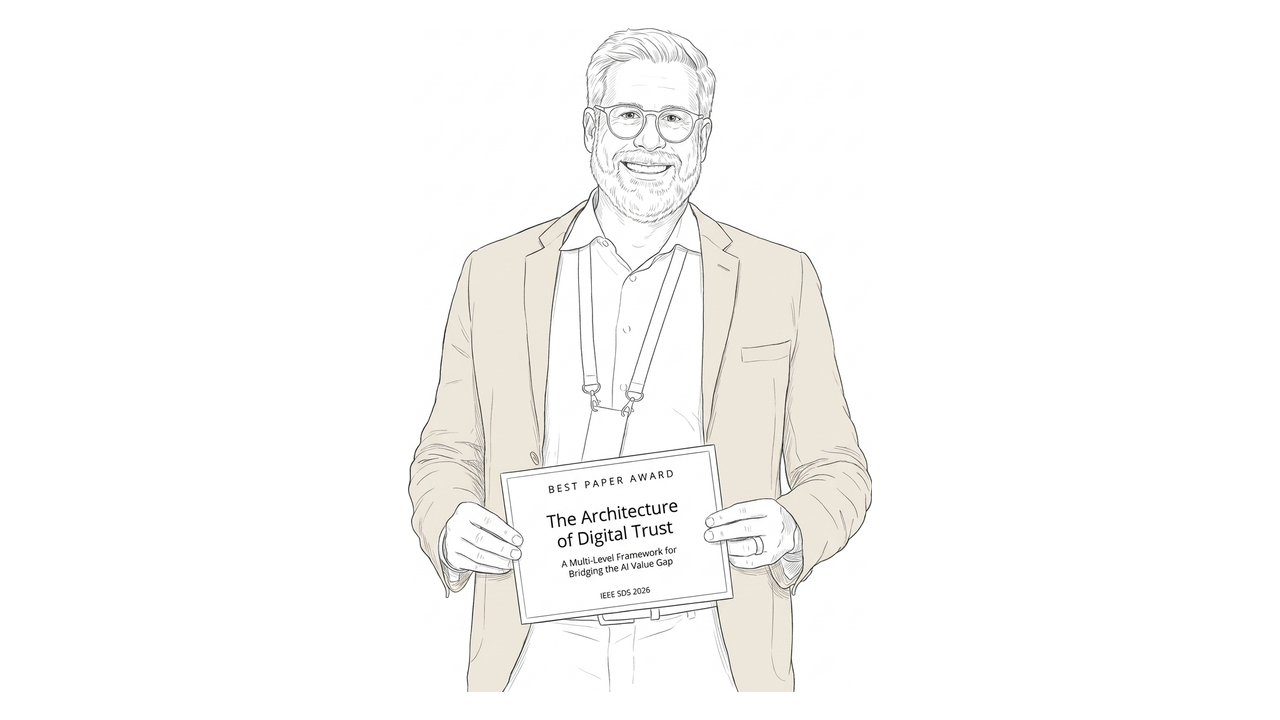 ResearchOpen to read
The Trust Problem Nobody Wants to Name
Everybody is spending on AI; almost nobody can say what they got back. A new paper, awarded the Best Paper Award at the IEEE Swiss Conference on Data Science and AI, names that gap and shows it is a trust problem wearing a technical costume: seven mechanisms, a four-layer architecture, an iceberg beneath it, and five design principles for closing it.
Read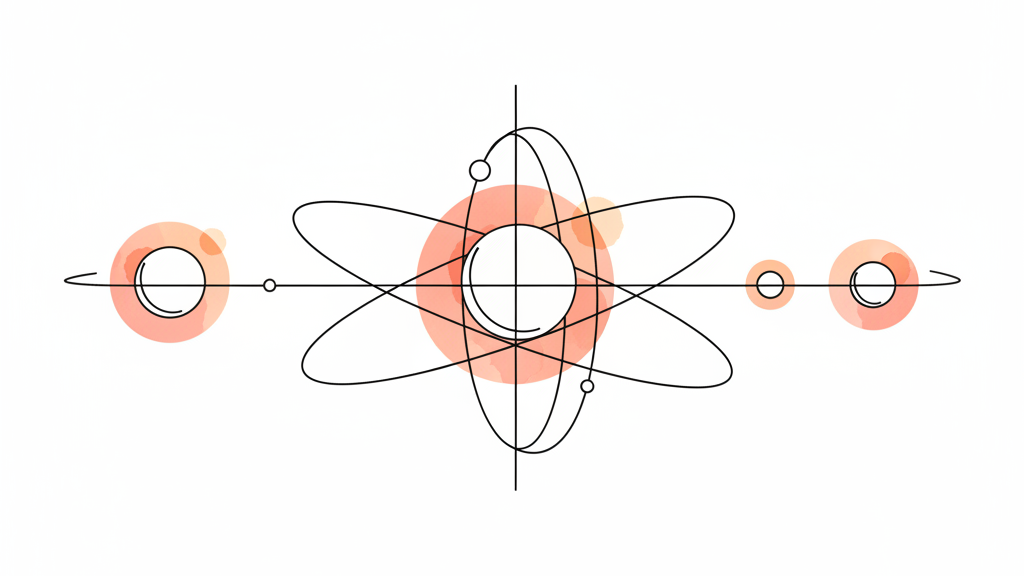 ResearchOpen to read
Digital Trust Is an Orbit, Not a Pillar
Trust is not one more pillar to stack. It is the orbit three bodies trace together: the model, the person and the organisation. Why the three-body problem is the honest metaphor for trustworthy AI, and how to tell where you are in the orbit.
Read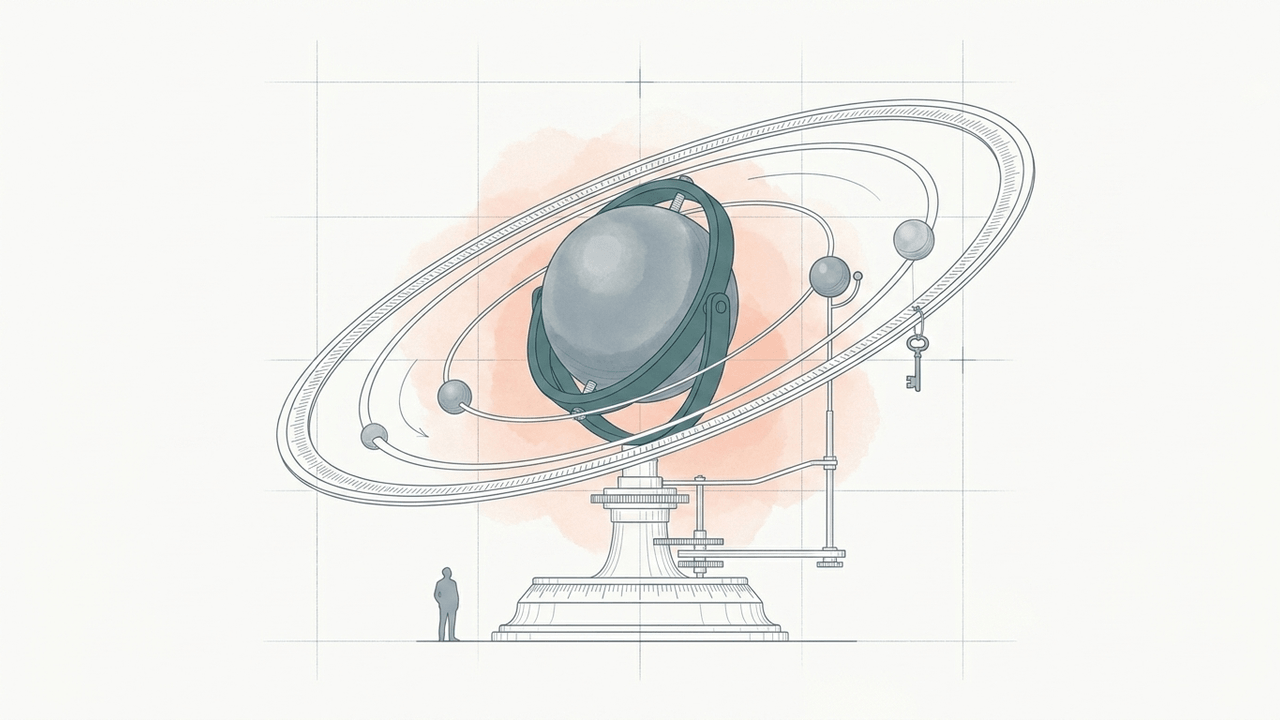 ResearchOpen to read
Agents Will Act for Us. Who Vouches for Them?
When agents start acting for us, trust moves from outputs to actors. Reading Michael Casey’s case for proof of control alongside our three-body picture of digital trust: where convenience quietly pulls authority toward a few global platforms, how validant.ai answers it, and a closed beta for scientific validation opening in Q3 2026.
Read